
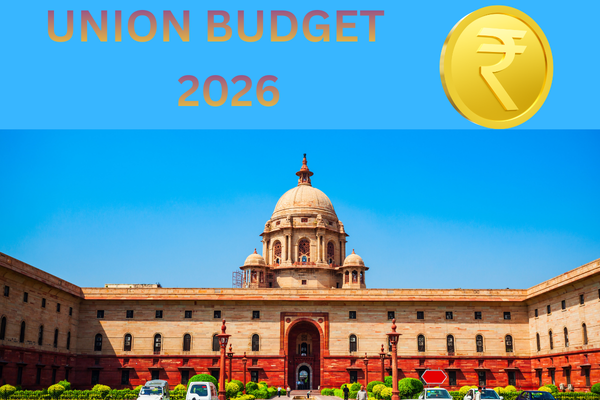
The Union Budget 2026 is one of the most important financial documents of India. It was presented by Finance Minister Nirmala Sitharaman on sunday, 1st February 2026 at 11:00 AM in the Parliament nine consecutive times.This is the first time in Indian history that the Union Budget has been presented on Sunday. This budget outlines the country’s financial plan — how the government will earn and spend money in the financial year from 1st April 2026 to 31st March 2027.
Table of Contents
As per the Indian Constitution, Article 112, the government must present an Annual Financial Statement, commonly known as the Union Budget.
The term Budget comes from the French word “Bougette”, meaning a small leather bag or purse.Over time, it evolved to represent a financial plan that details expected income and planned spending.In modern governance, a budget reflects the economic vision and policy direction of a country.
History of the Budget System in British India
The tradition of presenting government budgets in India began in the British colonial period. The very first budget for India was presented in 1860 by James Wilson ,a British economist and the first Finance members of the Viceroy,s Council.This is often considered the start of formal budget presentations in Indian financial history.
History of the Budget in Independent India
First Budget After Independence
After independence, India’s first Union Budget was presented by Sir R. K. Shanmukham Chetty on 26 November 1947. It was an interim budget, covering the early phase of independent India.
Subsequent Evolution
In the early years after independence, budgets were presented during February or March every year. At first, the timing and format were inherited from British practices. Over time, the system evolved to fit India’s democratic and economic needs.
Traditional Timing of Union Budget Presentations
Old Practice: Evening Presentations
For decades after independence, the Union Budget was presented in the evening, often around 5 PM. The reason for this tradition was linked to the British era — it allowed the budget to be presented in India’s evening while the British Parliament was in session in the morning, due to time differences between the countries.
Change to Morning Presentation
In 1999, Indian Finance Minister Yashwant Sinha changed the budget presentation time to 11 AM, bringing it closer to the general working hours and making it more accessible.
Shift to February 1
Until the mid-2010s, budgets were traditionally presented on the last working day of February. Starting in 2017, the date was changed to 1 February to allow more time for parliamentary discussion and approval before the new financial year begins on 1 April.
In 2026, this tradition continued — and for the first time in independent India, the Union Budget was presented on a Sunday.
Highlights of the Union Budget 2026
Main vision of the Union Budget 2026 is-
Speed – Increase productivity by accelerating the pace of economic development.
Capacity – To enhance the capabilities of the people , so that they act as a partner in the progress of the country.
Inclusivity – Inclusive development with the participation of everyone (sabka sath sabka vikas).
The 2026 Budget focused on several key themes: fiscal discipline, economic growth, infrastructure, and reforms to support future growth.
Record Capital Expenditure Push
- A capex (Capital expenditure) increased to around ₹12.2 lakh crore
- Strong focus on infrastructure, highways, railways, ports and urban development
Massive Infrastructure Expansion
- Announcements of 7 high-speed rail corridors
- Special corridors will be created for rare earth minerals to reduce import dependence and boost critical mineral processing
- To set up an Infrastructure Risk Guarantee Fund to provide prudently calibrated partial credit guarantees to lenders
- Expansion of national highways
- Investment in multimodal logistics parks
- Boost to waterways & port connectivity
Defence Gets One of the Highest Allocations
- Defence budget increased to Rs 7.85 lakh crore
- Strong push to Aatmnirbhar defence and domestic technology
- Modernisation of armed forces
Big Announcements for Education
- 5 University Township in the vicinity of major industrial and logistic corridors
- A girl’s hostel in Higher Education STEM institutions in every district
- Setting up or upgrading of four Telescope Infrastructure facilities
Healthcare & Medical Education Boost
- To position India as a global Biopharma Hub, Biopharma SHAKTI will invest Rs 10,000 crore over the next 5 years
- Big Biopharma manufacturing mission targeting Diabetes, Cancer, Autoimmune disorders
Manufacturing & MSMEs
- Exports unlocked for Artisans & small businesses
- Rs 10 Lakh cap per courier export consignment removed,enabling higher value shipments without restriction
- Strengthening India’s position as a global manufacturing hub
Agriculture & Rural Development
- Launch of “Bharat-VISTAAR” AI tool to empower farmers
- Support for farm productivity & supply chains
- Focus on farmer income stability
Tax & Financial Market Announcements
- Securities Transaction Tax (STT) increased on derivatives
- No major changes in income tax slabs
- Focus on fiscal discipline over populist tax cuts
Electronics & IT sector
- Semiconductor Mission 2.0 with Rs 1.5 Lakh crore
- Tax holiday till 2047 for foreign companies using Indian data centres
- A 20+ year runway to make India a global data infrastructure hub
- Provide a 15% cost-based safe harbour where the Indian data centre provider is a related entity
- To raise the IT services safe harbour threshold from Rs 300 crore to Rs 2000 crore
Power Sector
- Focus on grid modernisation & BESS storage
Renewable Energy
- Tailwinds for Solar & Green Hydrogen
- 35 capital goods for EV batteries and 28 for mobile phone batteries proposed for custom duty exemption
- Rs 20,000 crore for R&D to reach 100 GW capacity by 2047
Tourism
- Setting up a National Institute of Hospitality as a bridge between academia, industry and the Government
- India to hostthe first ever Global Big Cat Summit
- Development of Buddhist Circuits in North-eastern region of India
- National Destination Digital Knowledge Grid to digitally document all places of significance.
Impact of Union Budget 2026 on the Share Market

After the Union Budget 2026 speech, Indian stock markets reacted negatively — major indices like the BSE Sensex declined by 1547 points and NSE Nifty 50 declined by 495 points . Analysts cited the increase in Securities Transaction Tax (STT) on futures and options as one key reason for market sell-offs.
Shortcomings of Union Budget 2026
While the Union Budget 2026 outlined ambitious projects and spending priorities, some critics feel:
- It lacked major relief measures for the common man.
- Some reforms were viewed as slow to address immediate issues like inflation or tax burden.
The stock market reaction showed investor concerns about certain tax changes
Conclusion
The Union Budget 2026 reflects India’s long-term growth vision, balancing fiscal discipline with infrastructure expansion and sectoral reforms. From its constitutional roots to its modern-day presentation, the budget has evolved into a powerful economic instrument.
While theunion budget 2026 focuses on future growth, addressing short-term concerns will be key to sustaining public and market confidence.