
India–EU Free Trade Agreement is finalized on 27th January 2026, concluding nearly two decades of negotiations. This agreement is widely being described as the “Mother of All Trade Deals” due to its economic scale, strategic depth, and global geopolitical significance. Covering trade in goods, services, investments, digital commerce, and supply chains, the India–Europe Free Trade Agreement is expected to redefine global trade dynamics in the 21st century. The free trade agreement aims to enhance economic cooperation and boost bilateral relations.
Table of Contents
Civilizational Context
“Yunan Misr Ruma sab mit gaye jahan se,
Ab tak magar hai baqi nam-o-nishan hamara.”
— Allama Iqbal
This celebrated verse underlines the decline of ancient European civilizations like Greece (Yunan), Egypt (Misr), and Rome (Ruma), while emphasizing the uninterrupted continuity of Indian civilization. India’s economic engagement with Europe is not a modern phenomenon but a civilizational constant spanning over two millennia.
India–Europe Trade Ancient Relations: A Historical Overview
Commercial interactions between India and Europe began well before the emergence of Christianity and Islam. From the 1st century BCE to the 3rd century CE, sustained maritime trade connected the Indian subcontinent with the Roman Empire through the Red Sea and the Indian Ocean. These exchanges were facilitated by advancements in navigation and the understanding of monsoon wind systems. Ancient texts such as the “Periplus of the Erythraean Sea” provide detailed accounts of Indo-Roman commercial exchanges, confirming that India was a central hub in ancient global trade.
Archaeological Evidence: Arikamedu
One of the most significant archaeological confirmations of Indo-Roman trade is Arikamedu, located near present-day Puducherry. Excavations at this site have revealed Roman amphorae, glassware, coins, beads, and jewellery, clearly establishing it as a Roman trading settlement and port. Arikamedu thus stands as concrete material evidence of long-distance economic integration between India and Europe.
Trade Surplus in Ancient India–Europe Commerce
Who Benefited More?
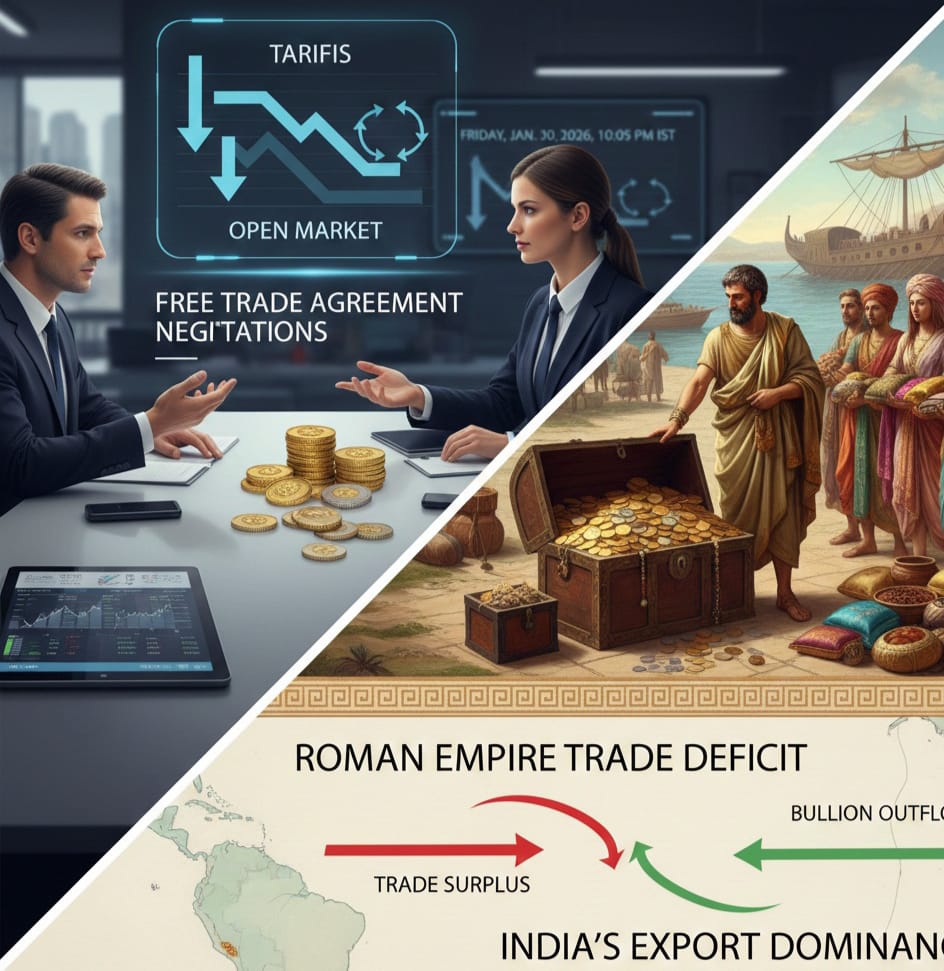
As part of the negotiations for the free trade agreement, both parties are focused on reducing tariffs and fostering a more open market.
Contemporary Roman sources acknowledged that the Roman Empire faced a persistent trade deficit in its eastern commerce. Payments for Indian goods were primarily made in gold and silver, leading to a continuous outflow of bullion from Rome. In contrast, India enjoyed a trade surplus, driven by its strong export capacity and limited reliance on imported manufactured goods.
Pliny the Elder and Concerns Over Trade Deficit
The Roman scholar Pliny the Elder, in his book “Naturalist Historia“, expressed concern over the excessive outflow of Roman wealth to India. He argued that Rome’s appetite for luxury imports was economically unsustainable, as the empire exported little of equivalent value. Pliny’s observations represent one of the earliest recorded critiques of trade deficits and reflect an advanced understanding of economic imbalance in ancient political thought.
The Contemporary India–EU Free Trade Agreement
Why It Is Termed the “Mother of All Trade Deals
The 2026 India–EU FTA is termed the Mother of All Trade Deals because it:
- Encompasses 1/3rd of Global Trade
- Brings together 2nd and 4th largest economies
- Catering to 25% of global GDP
- Covers nearly 2 Billion consumers
- Unlocks preferential access of $75 Billion in exports
No other bilateral trade agreement currently matches this scale and complexity.
Economics Benefits of the India-EU Trade Deal
- 9425 Tariff lines cleared for Indian goods
- Over 99% of Indian export value now enters the EU duty-free
- India gains predictable access to 144 EU Sub-sectors(IT, Financial, Education, etc.)
- Guaranteed post-study visa framework of at least 9 months
- Access for practitioners of Indian Traditional Medicine to work in EU states under their home titles
- Secured financial and technical support for Indian MSMEs to comply with carbon requirements
- Cooperation in Artificial Intelligence, Clean Tech and Semiconductors
- Entry and working rights for dependents/families of Intra-Corporate Transferees
- A framework to engage on Social Security Agreements over a 5-year horizon
When Will the Trade Deal Be Implemented?
The agreement is currently undergoing legal vetting and clarification by the respective legislative and institutional frameworks of India and the EU. Most projections suggest that the FTA will become operational by 2027.
The free trade agreement has the potential to create thousands of jobs and stimulate economic growth in both regions.
How Much Will India–EU Trade Grow?
Current trade volume (2024–25): USD 136.5 billion
Projected post-FTA trade: USD 200–220 billion
Long-term estimates suggest even higher growth as supply chains mature.
Impact on Global Geopolitics
The India–EU trade deal will:
- Reduce dependence on single-country supply chains
- Strengthen multipolar global trade
- Counter rising protectionism
Moreover, this free trade agreement is crucial for increasing India’s presence in the European market.
The free trade agreement is set to enhance collaboration in various sectors, including technology and environmental sustainability.
With the implementation of the free trade agreement, trade volumes are expected to rise significantly, benefiting both economies.
It positions India as a key economic bridge between the Global South and advanced economies.
Why Is the USA Unhappy With the India–EU Trade Deal?
The United States has imposed tariffs of up to 50% on selected Indian exports. The India–EU FTA allows India to diversify export markets, reducing reliance on the U.S. economy. This strategic shift has caused friction between Washington and Brussels.
Can India Offset Trump’s 50% Tariffs Through the EU Deal?
To a large extent, yes. Preferential access to EU markets enables India to:
- Absorb export shocks
- Maintain manufacturing growth
- Strengthen long-term trade resilience
While not a complete substitute, the India–EU FTA significantly cushions tariff-related losses.
Conclusion: From Indo-Roman Trade to a Global Economic Partnership
From ancient Indo-Roman trade routes to the modern India–EU Free Trade Agreement, history reveals a consistent truth: India has always been central to global commerce. The 2026 FTA is not merely a trade pact—it is a revival of a millennia-old economic relationship adapted to modern geopolitics.
The past worried Rome; the present empowers India. And the future promises a more balanced, multipolar global economy.